

Understanding the Complexities of Relocation Specialty Items Safely Transporting Pianos
Transporting a piano is far more complex than moving standard household furniture. Pianos contain thousands of moving mechanical parts housed within a delicate, heavy wooden frame. When handling Relocation Specialty Items Safely Transporting Pianos requires an understanding of structural weight distribution, internal string tension, and environmental sensitivity.
Standard moving techniques often fail when applied to instruments that weigh anywhere from 300 to over 1,200 pounds. A single improper lift can warp the rim, drop the soundboard, or throw the internal iron plate out of alignment. Preparing for this process requires careful planning, spatial assessment, and precise mechanical execution.
At First Class Movers LLC, we emphasize the physical science behind heavy instrument transport. Understanding the specific mechanical risks involved ensures that your valuable acoustic investment arrives at its destination fully intact and ready to tune.
Evaluating Spatial Pathways and Environmental Factors
Before moving a grand or upright piano, you must thoroughly evaluate the physical path through your home. The footprint of a piano leaves zero room for error in tight hallways, narrow doorways, or steep staircases.
Measuring Clearances and Turning Radii
Accurate spatial clearance is essential when planning Relocation Specialty Items Safely Transporting Pianos through historic or modern layouts. Measure the width and height of every doorframe, staircase landing, and hallway corner in advance.
- Doorframe Clearance: Ensure there is at least two inches of buffer space on all sides beyond the padded instrument profile.
- Staircase Incline: Calculate the pitch of any stairs to determine the proper distribution of weight and manual lifting power needed.
- Threshold Transitions: Identify uneven transitions between flooring types to avoid sudden impacts against delicate caster wheels.
Managing Climate Control and Humidity Shock
Pianos are primarily constructed of solid hardwoods, spruce soundboards, and high-tension steel strings. Rapid shifts in temperature and humidity during transit can cause the wood to expand or contract violently.
Industry research shows that sudden climate fluctuations can split a soundboard or loosen the tuning pins embedded in the pinblock. Utilizing climate-controlled transit vehicles helps stabilize internal moisture levels throughout the entire moving process.
The Structural Science of Disassembly and Padding
Proper disassembly is critical to changing the center of gravity on larger instruments like baby grands and concert grands. Attempting to transport a grand piano on its legs usually leads to leg shear and catastrophic frame damage.
First Class Movers LLC follows strict mechanical protocols to secure internal mechanisms before any physical movement begins:
- Securing the Keybed and Lid: Lock down the keyboard fallboard and top lid using soft moving ties to prevent sudden movement during transit.
- Removing the Pedals and Lyre: Carefully detach the pedal lyre assembly underneath to eliminate fragile hanging components.
- Dismounting the Left Leg: Lower the piano gently onto a padded piano board (skid board) before removing the remaining legs.
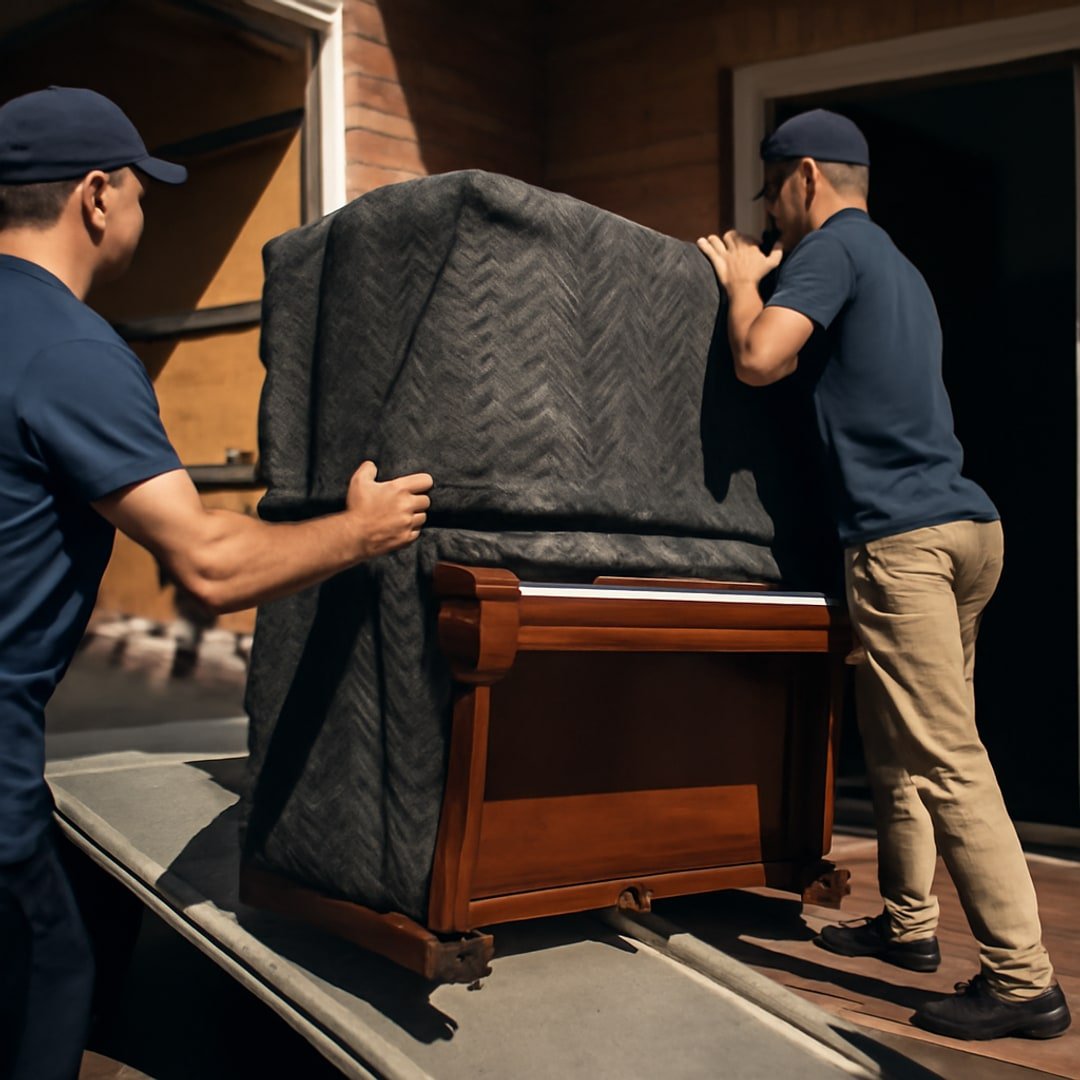
- Heavy-Duty Padding and Wrapping: Encase the entire rim, soundboard, and keybed in thick textile moving blankets, followed by industrial stretch film for moisture defense.
Upright pianos require a different approach. Because their weight is concentrated high up near the back soundboard, they remain upright and must be secured to heavy-duty equipment to prevent tipping.
Weight Distribution on Transit Ramps and Vehicles
Once padded and attached to a specialized skid board or piano dolly, moving the instrument requires continuous control over inertia. When managing Relocation Specialty Items Safely Transporting Pianos, gravity becomes the primary operational force.
Equipping team members with specialized shoulder harnesses transfers the load from the lower back to the larger muscle groups of the legs and torso. This prevents sudden drops while maintaining total stability on steep ramp angles.
Inside the transport vehicle, the instrument must be positioned directly against the internal wall framing over the main axle. Utilizing heavy-duty logistics straps ensures zero lateral movement during vehicle braking, acceleration, or turning.
Post-Relocation Acclimating and Stabilization
The relocation journey does not end the moment the instrument is placed in its new room. Pianos require a dedicated settling period after enduring vibrational stress and physical displacement.
Place the instrument against an interior wall away from direct sunlight, air conditioning vents, and fireplaces. Allowing the wood and steel to acclimate to the new indoor ambient climate for two to three weeks is essential before scheduling a professional tuning service.
Taking a patient, systematic approach guarantees that the integrity of the soundboard and internal mechanics remains completely sound for generations to come.
Secure Your Heavy Specialty Relocation Plan Today
Safely navigating the complex logistics of moving a valuable instrument requires specialized equipment, spatial awareness, and proper mechanical technique. Protect your investments and avoid structural property damage by relying on established industry protocols.
Contact First Class Movers LLC today to schedule a comprehensive assessment for your upcoming relocation, or explore our related guides on specialty item logistics to prepare your home for a seamless moving experience.